
For research centers and CROs
Multi-site field studies, run from one workspace.
Each clinic, coordinator, assessor and monitor sees what their role allows. Owners report from home. The Sites page shows which clinic needs a call today.

Access that follows the protocol.
Invite each person with a role, and limit them to the sites they work at. A coordinator at one clinic sees that clinic’s animals and owners only; an assessor scores animals without ever seeing an owner.
- Six roles: workspace owner, investigator, coordinator, assessor, monitor, viewer
- Access limited by site, and by study
- Allocations shown only to members marked unblinded

Monitoring by the study’s plan.
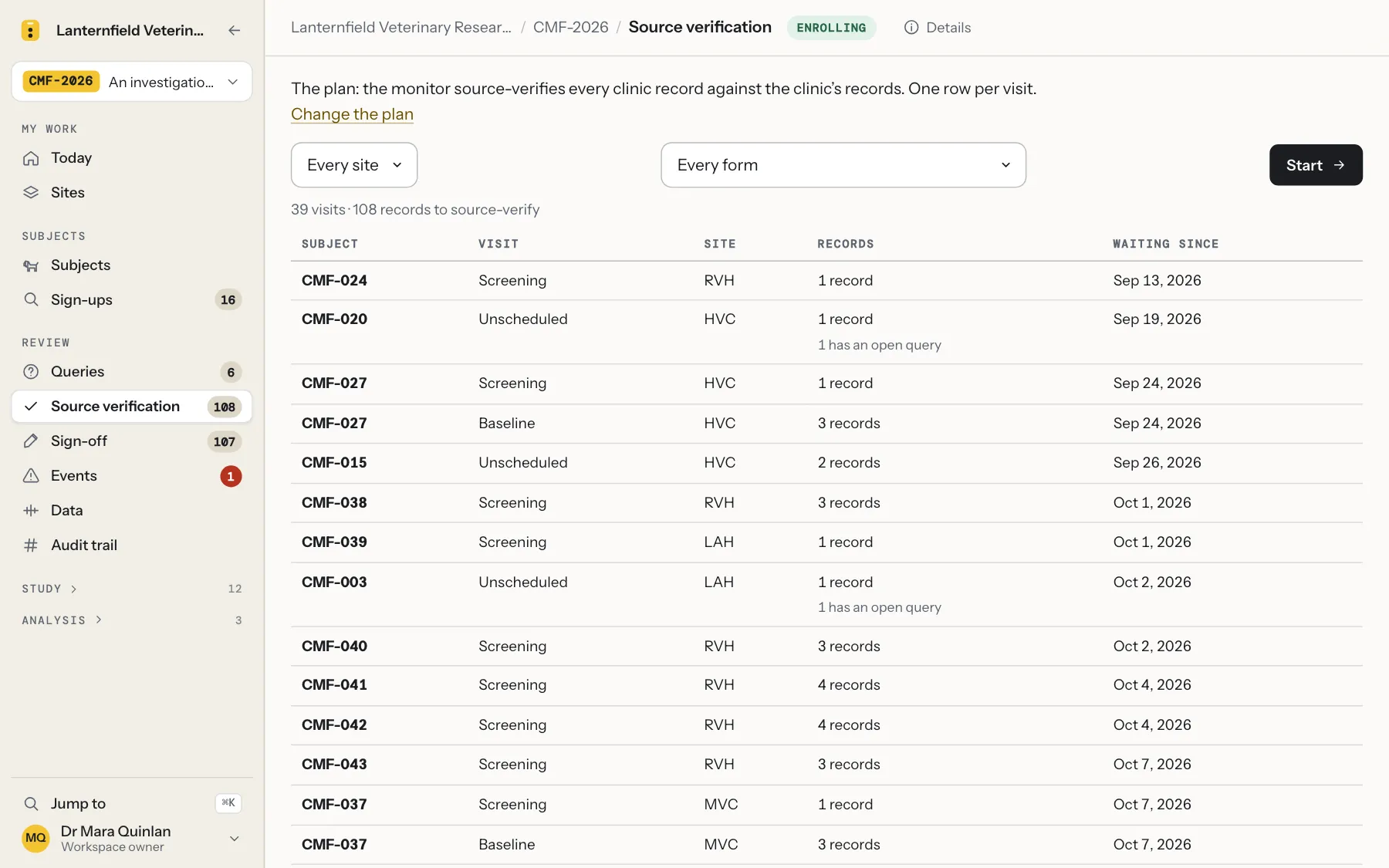
Write data checks before the first animal is enrolled; they raise a query as a value is saved. The study decides what is source-verified, every clinic record or chosen forms, and whether the investigator signs off by visit or by animal.
- Queries answered where they were asked, then closed
- Source verification queues grouped by animal and visit
- One password signs a group; each record gets its own signature
Supplies that reach the clinic before it runs out.
Each clinic’s stock, its pace and the day it runs out are read from the ledger. Shipments are built from those needs, labelled with a connected carrier account and received on the clinic’s shelf, with coded kits and lots kept apart from the blind.
- Inventory at the depot and every site, with what is on its way
- A shipment builder that proposes the contents, oldest lot first
- Devices issued to dogs and returned with prepaid labels

Know where each visit stands before the cut.
Pick a cut date and see, visit by visit, how many records are entered, complete, free of open queries, source-verified and signed off, and which animals stand in the way.

Blinding
Randomization and blinding that hold.
- Permuted blocks with sizes drawn at random, stratified by site or cohort
- Coded kits prepared by an unblinded member; blinded staff see the kit code only
- Breaking the blind for one animal takes a reason and a password, and it is on the audit trail
- A blinded member’s export never carries the allocation list
Validation
A validation package your QA team can read.
- Validation plan, user requirements, risk assessment, test protocol and report, traceability matrix and summary report
- SOPs for access and security, incidents and deviations, training and support
- Every release tested on a separate staging system before production
- Validation rules, hash rules, export formats and the randomization algorithm do not change during your study unless you agree in writing
Getting started
How a study goes live.
Bring the protocol to a demo.
We walk through the example study across four clinics, then look at how yours would be set up.